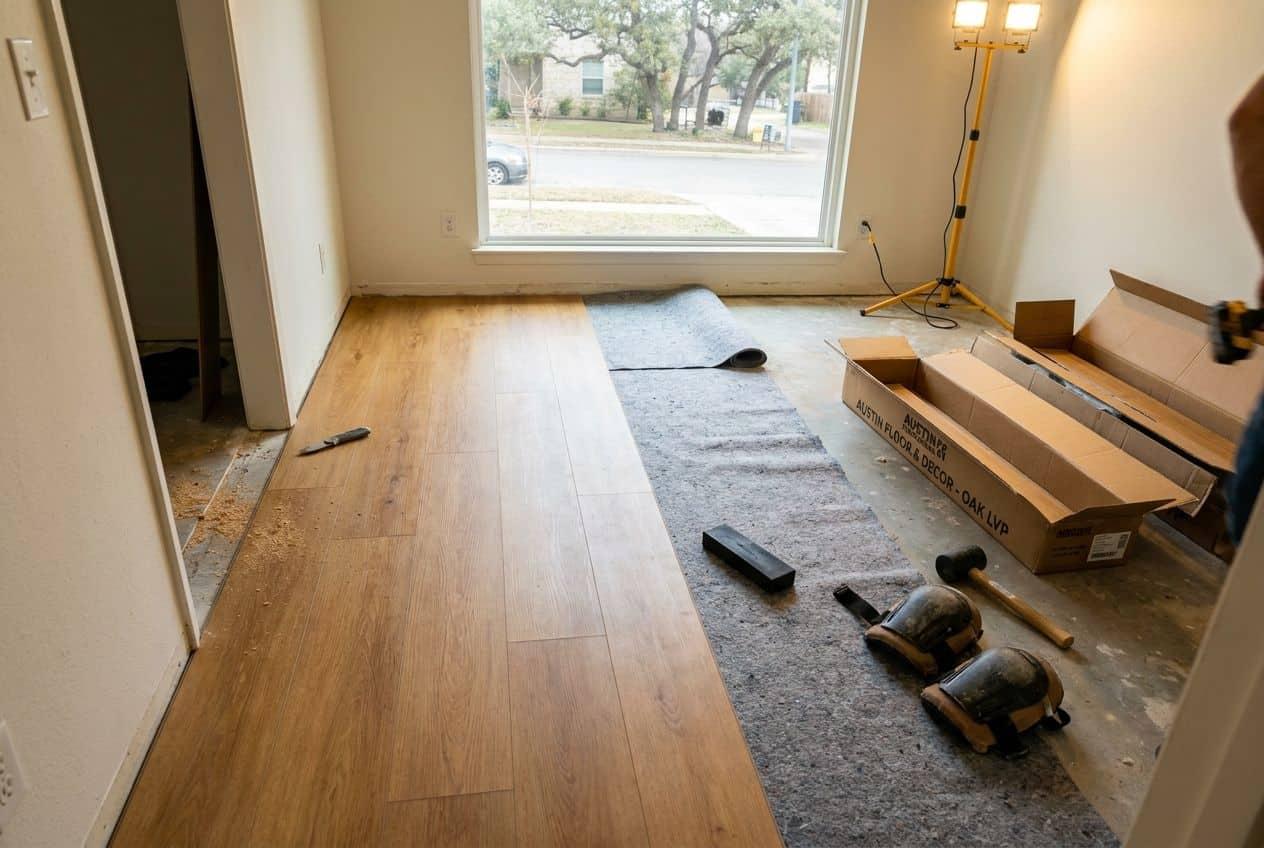
- LVP (luxury vinyl plank) is the most popular flooring choice in Austin: $9–$18/sqft installed
- Hardwood flooring runs $12–$25/sqft installed in Austin
- Tile flooring runs $10–$22/sqft installed depending on tile size and pattern
- Subfloor repairs add $2–$5/sqft to the total cost
- Across 129 estimates we wrote in the last 12 months that included flooring work, the median was $10,550
What ATX Actually Quoted in the Last 12 Months
Flooring pricing online is usually quoted per square foot with no context. Here's real context: over the last 12 months we wrote 129 estimates that included flooring work in the Austin area.
- A quarter came in under $3,624
- The median was $10,550
- Three quarters came in under $28,951
- The top 10% came in above $44,916
The frame matters: these are estimates that included flooring, not flooring-only jobs. The low end is single rooms and repairs. The high end is whole-house installations and flooring inside larger remodels, where new floors ran through kitchens, living areas, and bedrooms at once.
As a rule of thumb from those numbers: one or two rooms of LVP lands around $3,000–$6,000, and a whole-house flooring replacement typically runs from around $12,000 up to $30,000+ installed depending on square footage and material.
LVP (Luxury Vinyl Plank) — The Austin Favorite
LVP has become the dominant flooring choice in Austin over the past five years, and for good reason. It handles humidity, pet traffic, and the wear of daily life better than hardwood, at a fraction of the cost.
Installed cost runs $9–$18/sqft depending on product grade and square footage. Entry-level LVP ($9–$11/sqft) looks good but can feel thin underfoot. Mid-grade ($12–$15/sqft) is the sweet spot most homeowners land on. Premium LVP ($15–$18/sqft) has thicker wear layers and more realistic wood or stone looks.
For a 1,200 sqft open-plan main floor (common in 1990s–2000s Austin builds), expect $11,000–$18,000 fully installed with subfloor prep and transition strips.
Hardwood Flooring — Classic but Climate-Sensitive
Solid hardwood is gorgeous and adds undeniable resale value, but it's a commitment in Austin's climate. Humidity fluctuations — especially during the summer — cause expansion and contraction. Improperly installed hardwood will gap in winter and cup in summer.
Installed cost for solid hardwood runs $14–$25/sqft in Austin. Engineered hardwood (a real wood top layer over plywood core) handles humidity better and installs for $12–$20/sqft. Both options look identical when done well.
For a typical 800 sqft living/dining area, budget $10,000–$20,000 for hardwood. If there's existing flooring to remove and subfloor repairs needed, add $1,500–$3,000.
Tile Flooring — Best for Wet Areas and Durability
Tile is the right call for kitchens, bathrooms, and Austin mudrooms. It doesn't care about humidity, spills, or heavy traffic. The downside: it's hard underfoot and grout requires maintenance.
Installed tile costs run $10–$22/sqft for standard jobs — $10–$14/sqft for basic 12x12 ceramic, $14–$18/sqft for 24x24 porcelain, $18–$22/sqft for complex patterns (herringbone, versailles) or oversized formats.
Natural stone tile (slate, travertine, marble) runs $20–$42/sqft installed and requires sealing. Beautiful in the right home — just know the maintenance commitment upfront.
Subfloor Prep and What Adds to the Bill
Subfloor condition is the wildcard in most Austin flooring projects. Older homes (pre-1990) often have subfloor damage from moisture, previous tile, or settling. Repairs run $2–$5/sqft and are non-negotiable — floating flooring over a bad subfloor leads to squeaks, movement, and early failure.
Furniture moving adds time but we handle it — no need to empty the house before we arrive. Stair nosing and transition strips for multi-room jobs add $200–$600 typically.
Most 800–1,500 sqft flooring projects take 2–4 days. Tile work takes longer due to setting and grout cure time.
Austin adds two local wrinkles. Most homes here sit on concrete slabs over expansive clay soil, and those slabs move — floor leveling is a common and legitimate line item, because floating floors need a flat slab to perform. Older central Austin homes on pier-and-beam foundations are the opposite case: once the old flooring is up, wood subfloor repairs are common before anything new goes down.
One caution for pre-1980s homes: old sheet vinyl, linoleum, and the black mastic under them can contain asbestos. Don't sand it or rip it out blind — get it tested first. If it tests positive, the standard playbook is either professional abatement or encapsulating it under the new floor. Both are routine; the mistake is disturbing it without knowing.
Where the Money Goes
The materials-to-labor split depends on what's going down:
- LVP and laminate: roughly 50–60% materials, 40–50% labor. Product grade drives the total more than anything else.
- Hardwood: roughly 55–65% materials, 35–45% labor for standard installs. Refinishing existing hardwood flips this — it's nearly all labor.
- Tile: labor often exceeds materials. Setting, leveling, and grouting are slow, skilled work, which is how a $4/sqft tile becomes a $14/sqft floor.
Across every type, removal and disposal of the old flooring plus subfloor prep adds $2–$5/sqft. When one bid is far below the rest, this is usually the line that's been left out — and it doesn't disappear, it just shows up as a change order later.
Ways to Keep Flooring Costs Down
- Do connected areas in one project. One mobilization across 1,400 sqft costs meaningfully less per foot than three separate small jobs a year apart — and the floors actually match.
- Buy mid-grade LVP. The $12–$15/sqft installed tier is the sweet spot: a wear layer thick enough to last, realistic looks, none of the premium markup.
- Skip the fancy layouts. Herringbone and diagonal patterns add labor and material waste. Straight-lay planks read clean in almost every room.
- Empty the rooms yourself. We move furniture, but cleared closets and packed-away fragile items speed the job up, and faster is cheaper.
- Defer the stairs. Stairs run $80–$150 per step. If budget is tight, they're a clean phase-two item.
And a scheduling perk: flooring is cosmetic work, so no City of Austin permit is needed — it's one of the simplest projects to get on the calendar.
Frequently Asked Questions
How long does flooring installation take?
LVP or laminate on a 1,000–1,500 sqft open floor plan typically takes 2–3 days including removal of old flooring and subfloor prep. Tile takes longer — plan 4–7 days to allow for proper setting and grout cure time. Hardwood is similar to LVP in timeline.
Is LVP or hardwood better for Austin's humidity?
LVP wins on practicality in Austin's climate. It doesn't expand and contract with humidity, handles spills without damage, and costs less. Engineered hardwood is the middle ground — real wood look with better dimensional stability than solid hardwood. Both are great options depending on your priorities and budget.
Do you move furniture before installing flooring?
Yes — furniture moving is included in our flooring projects. We move and replace standard furniture (couches, beds, dressers, tables). We ask homeowners to remove fragile items, electronics, and the contents of closets before we arrive.
How do you handle flooring on stairs?
Stairs are a separate line item, typically $80–$150 per step for LVP or hardwood stair treads and risers. A standard 13-step staircase runs $1,000–$2,000. Tile stairs are more complex and expensive. We include stairs in the estimate if you want them matched to the main floor.
How much does whole-house flooring cost in Austin?
For a typical 1,500–2,000 sqft Austin home, whole-house LVP runs roughly $13,000–$36,000 installed depending on grade, with hardwood and tile higher. For context: across 129 estimates we wrote over the last 12 months that included flooring work, the median was $10,550 and three quarters came in under $28,951.
Do I need a permit to replace flooring in Austin?
No. Flooring replacement is cosmetic work and doesn't require a City of Austin permit. The rare exception is structural repair — if we open up a pier-and-beam floor and find damaged framing, fixing structure can require a permit, and we flag it before proceeding.
Ready to Start Your Project in Austin?
Get a free estimate from ATX Construction — Austin's licensed, insured remodeling contractor. No pressure, no obligation.